MS1 final: Anti-Propaganda
A speculative scene of Blue Propaganda and a sensory organs augmentation design.
Abstract:
Technologies did not make the world as perfect as it is imagined. In this era of freedom, are we really more free? At least our freedom of scenes is being deprived by propaganda, which is becoming stronger and more ubiquitous because of the blossom of information technology development.
The development pattern is significant to predict what would happen in the next step. With the aim of predicting the future of propaganda, in this paper I tried to extract the development pattern of the form of propaganda by analyzing the history of the development of it.
In this paper, I introduce a speculative scene of propaganda and a corresponding sensory organs augmentation device design. The device consisted of two functional parts. The eyes blocking part makes sure the position of the eyes can not be detected, so that the information cannot be projected to the front of the eyes. The sound filter part filter out the voice defined as spam by the users. It is deliberately retro designed.The strong contrast between the 1960s’ design style and the hi-tech scene calls attention to the social change imposed on us through advanced information technology.
Keywords:
Human augmentation; Human senses; Mass media propaganda; Natural liberty; Freedom of perception.
ACM Classification Keywords:
J.5 [Art and Humanity]
Introduction:
Propaganda, based on the definition given by Merriam-Webster, is that the spreading of ideas, information, or rumor for the purpose of helping or injuring an institution, a cause, or a person and that ideas, facts, or allegations spread deliberately to further one's cause or to damage an opposing cause. It is more related to political and commercial purpose.
Propaganda has been studied as history, journalism, political science, sociology, psychology, and from an interdisciplinary perspective.
According to the Jowett in the Propaganda & persuasion, there are three types of propaganda based on the content, that is white propaganda, black propaganda, and gray propaganda[1].
- White propaganda
- The information is correct but would have the focal point on specific aspects.
- To build credibility and positive impression with the audience for the future usefulness at some time in the future.
- Example: VOA (Voice of America) and Radio Moscow during peacetime.
- The information is correct but would have the focal point on specific aspects.
- Black propaganda
- The content of dissemination is lies, fabrications, and deceptions, which are often described as disinformation.
- The source is concealed or credited to a false authority
- Example: the political propaganda of Nazi government which twisted some of the facts of the Jews nation.
- The content of dissemination is lies, fabrications, and deceptions, which are often described as disinformation.
- Gray propaganda
- It is a between state of white and black propaganda.
- The information is slightly distorted for a certain purpose.
- The source of gray propaganda may not be correctly identified and the accuracy is uncertain.
- Example: Companies would distort the statistics advertising the results that a product could not achieve.
- It is a between state of white and black propaganda.
The history of propaganda is long. Only since the 100 years ago with the advent of technologies that allow us to spread information to a mass group has it evolved to a scientific process capable of influencing a whole nation of people[2].
In the age before industry age, the media and the effect of propaganda were limited. The effectiveness of propaganda during this period was mainly achieved by interpersonal dissemination.
In the age before the information age, the media of propaganda include press, radio, television, film, posters, meetings, door-to-door canvassing, handbills, buttons, billboards, speeches, flags, street names, monuments, coins, stamps, books, plays, comic strips, poetry, music, sporting events, cultural events, company reports, libraries, and awards and prizes[3]. The effectiveness of propaganda during this period was achieved through mass media distribution. One of the famous example of propaganda case is the US military recruiting poster, the Uncle Sam, during the wartimes. From April 1917 to autumn 1918, more than four million pieces of it were printed[4].
In the information age, propaganda increasingly relies on digital media and online platform, which allows information broader and more efficiently. The effectiveness of propaganda during this period is achieved by the speed of information dissemination and the accurate delivery of information. Technologies enable propaganda to be sent to target audience instantly and respectively. Our online behaviors are being surveilled and we are being analyzed through the networks. With the profiling software, our every click, shopping history or even eyes movements could be tracked. With Neurotechnologies and psychological analysis, our minds are being read and our online profile are being set up. With big datas, our datas are compared with datas from other users and our behaviors are being predicted. Network data acquirers know us better than we think. They want us to see what they think we would be eager to see and to hear what they think we would be eager to hear. According to the agenda setting theory put forward by Paul Lazarsfeld, although the information we perceived would not directly change our minds, it would have a great potential influence on them. Perception affects minds. Can it be considered as the invasion of individual will from general will and artificial intelligence?
Also, the development of the Internet has evolved a new business model, every free website on the internet is paid for by advertising propaganda, which makes mandatory advertisement inevitable. This system works to keep most of the internet free for consumers because of the massive scale of online advertising but also give birth to pop-ups and spam, which are annoying forms of propaganda.
The Speculative Scene Description:
Blue represents futuristic technologies. According to the survey by 99designs, blue is chosen as a staple color by 59% of technology logo design contests on 99designs and appearing in 61% of logos from the top technology companies[5]. In this paper, I put forward a terminology of a new type of propaganda — Blue Propaganda, that is a form of propaganda which is mandatory and relies on advanced media technologies.
In this paper, a speculative dark future scene where information technologies are abused in aggressive forms of propaganda is imagined. In the case, technologies engulf humanity and further deprive the natural liberty, which is put forward by Adam Smith (qtd. In Fleischacker) who regards it as essential to justice with a concern for “independence” [6]. According to Gresham, the natural liberty philosophy assumed that sensible people would choose freedom if they had a choice and liberty is truly natural[7]. It can be imagined that in the near future, with development of information technologies, not only the online behaviors but also the offline behaviors are being watched and analyzed.
It is a duty-free society (as like the free internet world in the last era) in which mandatory propaganda substitutes the role that duty once played. To some extent it is a free society that citizens would not have to pay for, as like the Internet system. From the perspective of propagandists, individuals, mules that create value and recreate value through consumptions, are considered to be able to do more contribution to the society by being leaded to behave and consume under the influence of propaganda than paying taxes.
Blue propaganda, a new type of propaganda referring to the mandatory propaganda based on highly advanced media technologies, has seeped into every corner of our lives.
- Visual blue propaganda: With the development of projection technology, our ambient air become the display. By tracking the position of target audiences’ eyes, the visual
-
Aural blue propaganda: The advanced directional speakers are able to send different sound propaganda to different target audiences’ ears. Directional speakers are hidden everywhere, sending out sound propaganda like what mobile phone signal bases do now. Human ears are more vulnerable than human eyes because the hearing works 24/7 and it receives all sound information within the human hearing unconditionally.
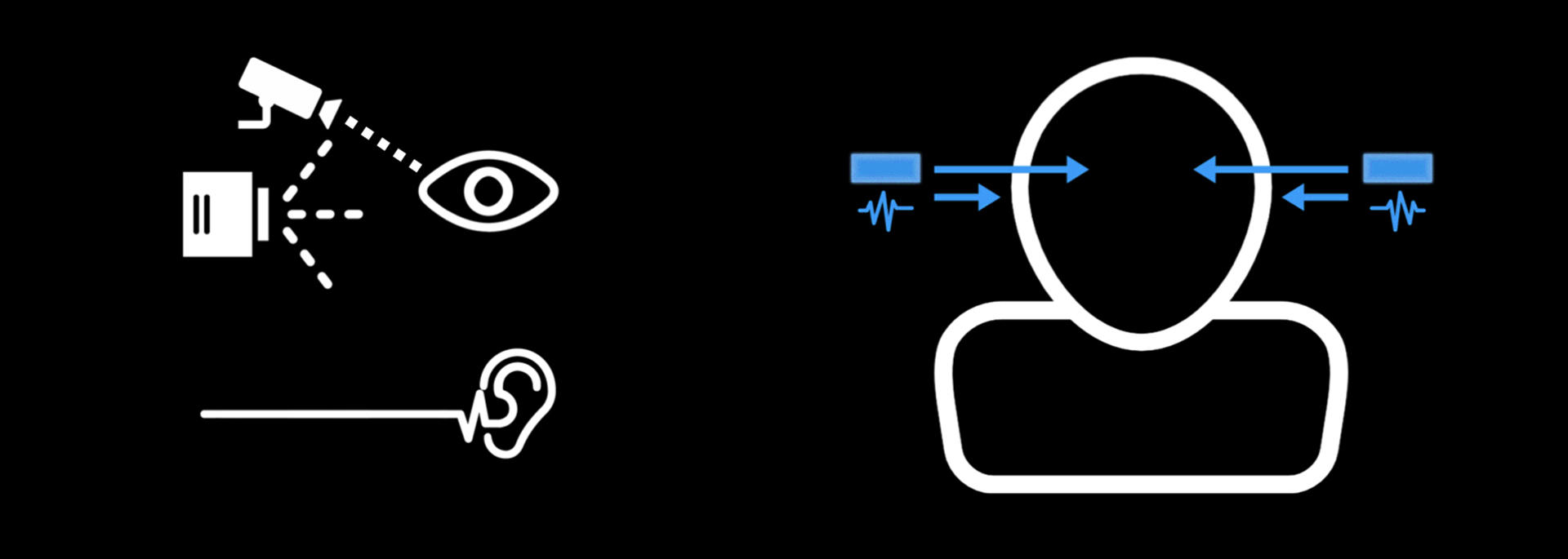
New terminologies, information violence and thought invasion, are invented to protest the aggravating blue propaganda. From the perspective of the protestors, the blue propaganda go against the humanity and natural liberty. The freedom of perception is even more important than the freedom of speech. The blue propaganda would not change human minds directly but it would have a long term deep and profound influence on them, resulting in the loss of personal will to some extent.
Protestors tried to eliminate the blue propaganda. They had three strategies: eliminating the source of the propaganda, cutting off the dissemination of the propaganda, and reframing the human sensory organs to block the propaganda.
- Eliminating the source of the blue propaganda: The strategy failed. Propaganda is for the sake of the commercial or political profit of the propagandists. In a society valued interests and profits, it is impossible for them to give up such a powerful tool.
- Cutting off the dissemination of the blue propaganda: The strategy failed. Freedom of expression remains to be one of the basic right of the modern society. Nobody has the right to prevent others from using the public space media to express their notions.
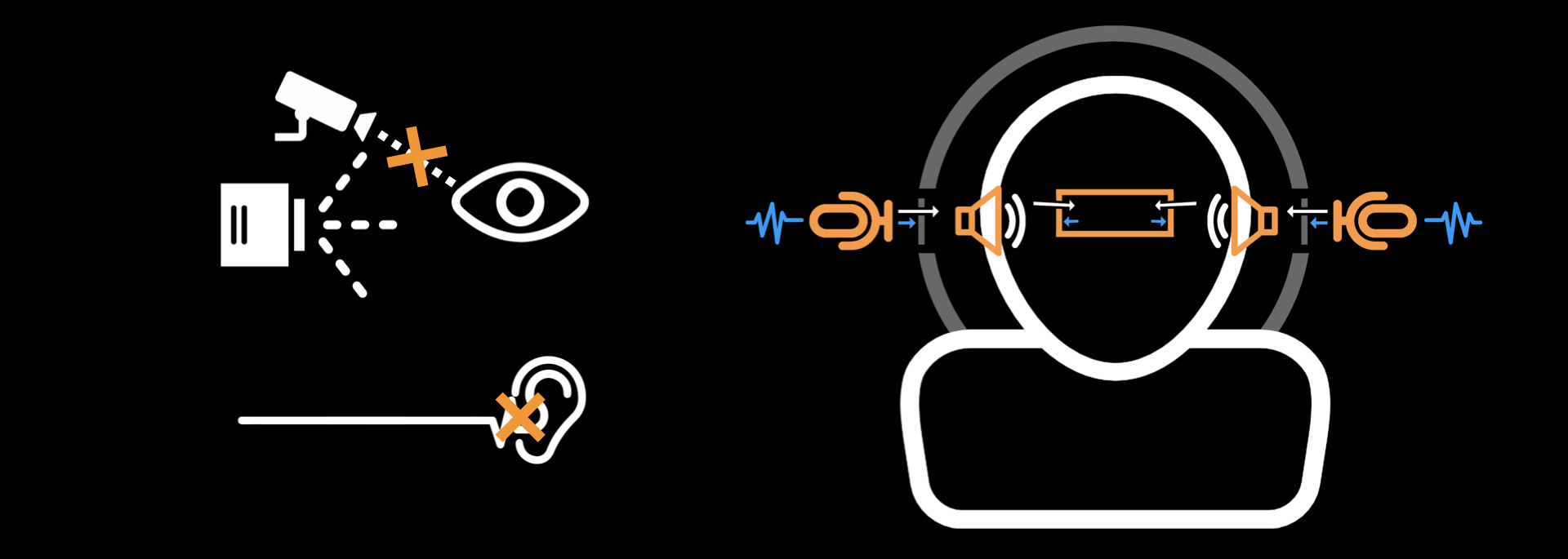
- Reframing the human sensory organs to block the blue propaganda: though it was a reluctant choice, it was the only feasible strategy. The solution was to lock the sensory organs in a room, the door of which only open to the information that we want to get, which is similar to the spam blocker of the internet browser in the last era. From their perspective, freedom of perception can only exist in cages. A perception protection gear was designed.
Related Works:
"Arkangel" is episode of the anthology series Black Mirror written by Charlie Brooker and directed by Jodie Foster. In the episode, "Arkangel" is the name of an implanted chip technology that allows a parent to track and monitor their children, as well as pixelate images that would cause them distress. The parent, along with algorithms, control the children’s perception.
"Fifteen Million Merits" is another episode the anthology series Black Mirror. It was written by series creator and showrunner Charlie Brooker and his wife Konnie Huq and directed by Euros Lyn. In the story, a society in an enclosed is depicted which is an automated space, with nearly every surface an interactive video screen with personalized entertainment and frequent advertising. It reflects the information violence concept put forward in this paper.
Noise-cancelling headphones. Active noise control (ANC), also known as noise cancellation, or active noise reduction (ANR), is a method for reducing unwanted sound by the addition of a second sound specifically designed to cancel the first. A noise-cancellation speaker emits a sound wave with the same amplitude but with inverted phase to the original sound. The waves combine to form a new wave, in a process called interference, and effectively cancel each other out, which is an effect which is called destructive interference.
Device Design Description:
The gear has two separated functional parts, the aural propaganda filter and the anti-eyes-positions-tracker. The aural propaganda filter can eliminate the sound defined as aural propaganda from other sounds. The anti-eyes-positions-tracker prevents eyes from being detected and tracked by the camera so that the visual propaganda can not be accurately delivered to the eyes.
Each aural propaganda filter consists of a microphone, a speaker, a microprocessor, and a sound insulation layer. The sound insulation layer isolate human ears from the environment, making them can not perceive the sound in the outer environment. The microphone collects the sounds in the outer environment. The microprocessor transfers the sounds to electric signal, analyzes the signal using the fast Fourier transform (FFT), eliminate the part considered as “aural propaganda” using a trained machine learning model, and reproduce a sound without aural propaganda. The speaker plays the sound by the ear.
The anti-eyes-positions-tracker is a porous cover, which allows the users to see but prevented their eyes bu be seen by camera from a distance.
The perception gear adopt the design language of electronic product design style of 1960s, which is the time before information era, when people were so fascinating with imagining the scenes of the technologies highly developed future.

Device Design Description:
How to get the freedom of perception in the era of information explosion?
Is personal will being invaded by general will and artificial intelligence? How to keep personal will with the help of technology?
How can technologies protect human natural liberty?
What should be the role of technology, the ruling machine of central power or the liberator of individual desire?
References:
- Jowett, Garth S., and Victoria O'donnell. 2018. Propaganda & persuasion. Sage publications.
- Manzaria, Johnnie, and Jonathon Bruck. 1999. Media's Use of Propaganda to Persuade People's Attitude, Beliefs and Behaviors.
- Manzaria, Johnnie, and Jonathon Bruck. 1999. Media's Use of Propaganda to Persuade People's Attitude, Beliefs and Behaviors.
- “American Treasures of the Library of Congress Memory Gallery C.” Planning D-Day (April 2003) - Library of Congress Information Bulletin, Victor, 1 Aug. 2007, www.loc.gov/exhibits/treasures/tr11c.html#obj23.
- 99designs. “How Do You Choose Colors for a Technology Logo?” 99designs, 99designs, 99designs.com/logo-design/psychology-of-color/technology.
- Fleischacker, Samuel. 1999. A third concept of liberty: judgment and freedom in Kant and Adam Smith. Princeton University Press.
- Gresham, Perry E. “Natural Liberty | Perry E. Gresham.” Foundation for Economic Education, Foundation for Economic Education, 1 Oct. 1981, fee.org/articles/natural-liberty/.